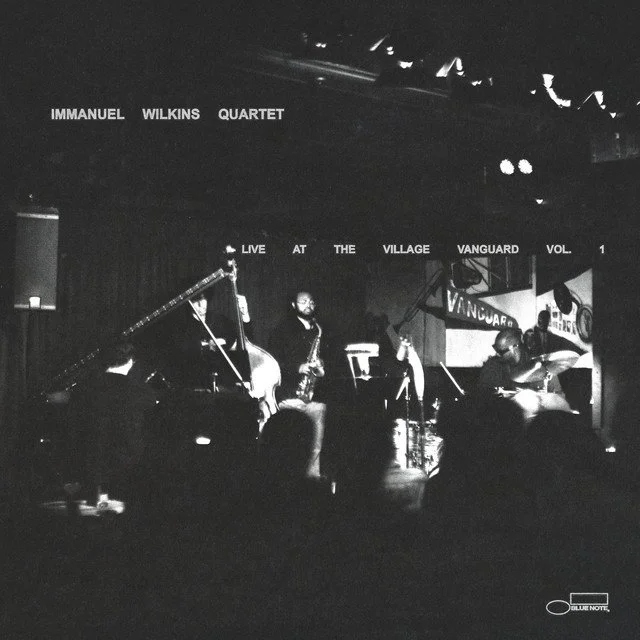
Immanuel Wilkins remains the only alto saxophonist of his generation to come out of the shadow of Kenny Garrett. Still in his twenties, he formed his current quartet in 2017 and his live performances consistently deliver an intensity few can match. Now a standout stylist, he has racked up 19 sideman sessions and, among many others, performed with Bob Dylan, Wynton Marsalis, Kenny Barron and Jason Moran. He released his first of three standout Blue Note studio albums, Omega, in 2020, but these are his first live sets. Recorded at NYC's Village Vanguard, and issued as three separate albums, the recordings find Wilkins free-flowing and focused quartet shaking the acoustic jazz mainstream into an intense and soulful contemporary jazz shape. The music is expansive and outgoing and, as his collaborations with filmmakers and visual artists would suggest, inspires the imagination as well as soothing the soul. Wilkins alto-sax style has the same pithy phrasing, blues-drenched aesthetic and intense highs as his prime influence, Kenny Garrett. And like Garrett, the lineage of Charlie Parker, John Coltrane and Maceo Parker is clear. He then stirs this already heady blend with controlled dynamics, fresh harmonic shapes and a shapeshifting balance of freedom and form. His playing is rich with tonal contrasts that range from high-pitched hollers and phonic wails to breathy ruminations and phrases that rampage through the registers, tumble at speed and flutter whimsically before darting off at speed. And whereas Garrett's strength of purpose renders his band members as inspirational support, Wilkins collective aesthetic finds inspiration from within. On all three albums, moods vary, tracks are long and the group's spirit and energy is evident from the outset. Volume 1 starts with the fast walking bass swing and modal pulse of Warriors' - bassist Ryoma Takenaga as solid as a rock - Volume 2 with the panoramic moods of The Big Country' and Volume 3 with the gentle primeval spirit of Ring Shout. As each set progresses, lilting themes turn playfully to the blues - pianist Micah Thomas a two-handed treat on Dollas - slow bums inch towards improbable highs and the repeated phrases of Waiting PT.l' induce al hypnotic state. Drummer Kweku Sumbry is a standout whether spitting beats, marking dynamics or swishing gently on the breathy ballad solitude of 'Composition II! Three great albums brimming with the excitement and in-the-moment detail of a well-worked set.
Mike Hobart - JAZZWISE AN
The grand, three-volume live outing is one of those gigs where even Charles Mingus wishes he had sat in. Sonny Rollins, too. The expansive effort goes down as easily as any of the classic Live At The Village Vanguardrecordings we built our collections on. Think of titles with Bill Evans or Art Pepper in them.
Immanuel Wilkins Quartet: Live At The Village Vanguard is not just a well-versed lesson in jazz history; it is a barn-burning addition to that very alive history. Equal parts cacophony and restive harmony; master thesis and frat-party blow-out, just one listen to the dark, effervescent hypnosis that "Charanam" espouses is all the proof anyone needs. But then the quartet gives generously on the sly and slinky "Waiting Pt 1." The bopping rush and rumble of "Warriors." The full-on charge of "The Big Country" into that very special Coltrane realm of spirituality, where Thomas, seemingly possessed by McCoy Tyner comps feverishly behind Wilkin's barley contained hysteria. That Sumbry and Takenaga are borne on the high-flying spirts of Jones and Jimmy Garrison only seals the deal. Even the howls of approval from the Vanguard crowd echo back to classic live recordings by the classic quartet.
It is relatively impossible to count the number of evolutions that transpire and conspire to make "Eternal" an absolutely around-the-bases, dance—in-the-end-zone performance. Thad Jones and Mel Lewis toast the fervent upstarts—no one on the Vanguard's fabled one-step—up stage has yet to turn thirty—who raise a great deal of both hell and glory as the track follows "Charanam" into listener history. That it serves to end "Volume One" only double-down swears to the promise that Immanuel Wilkins Quartet: Live At The Village Vanguard keeps royally and, without hesitation, on "Volume Two" and "Volume Three."
Like the many elders in the room and those on the storied stages of Heaven, Wilkins, Thomas, Takenaga, (recipient of the 2022 James Moody Jazz Scholarship ) and Sumbry, ( Cyrus Chestnut, Shabaka Hutchings), throw a most perfect light on the room, and it is a thrilling wonder to bask in it. It is a time-honored and well-argued fact that there lies a chasm of difference between listening to jazz and experiencing it. Immanuel Wilkins Quartet: Live At The Village Vanguard obliterates that barrier, hearts and horn held high.
Mike Jurkovic — ALL ABOUT JAZZ
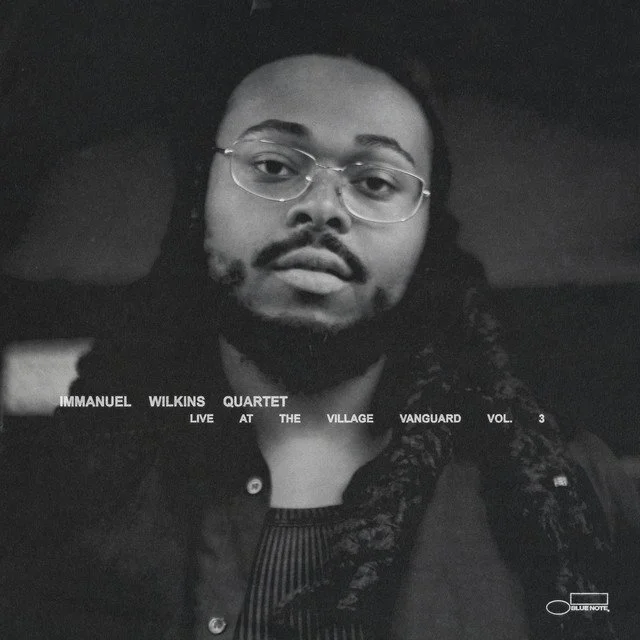
À 28 ans, l'altiste de Philadelphie s'offre pour son premier enregistrement live une trilogie au Village Vanguard de New York. Ce premier volume monumental confirme son statut d'acteur incontournable du postbop moderne. Immanuel Wilkins fait partie de cette génération, avec Kamasi Washington, habitée par l'histoire de leur communauté et liée à la spiritualité de l'Église Noire, dans la lignée des John Coltrane, Pharoah Sanders ou Sun Ra. La musique de Wilkins est imprégnée d'héritage et de mysticisme. Ses trois premiers albums studio etaient pour lui des artefacts à la postproduction presque "anti-jazz".*. Son album live se devait donc d'être un retour à cette « pratique de sonorité improvisée, d'écoute congrégationnelle et de rituel dévotionnel » et d'amener l'auditeur à experimenter le jazz dans l'instant de sa création plutôt que dans l'écoute d'un produit fini. Ce premier set se vit comme une expérience d'éveil spirituel, et pas question d'arriver dans ce club mythique sur la pointe des pieds : d'emblée, avec Warriors, Wilkins et ses fidèles se lancent dans une rageuse et tumultueuse profession de foi, se livrant entiers et sans retenue. Composition // invite à une sublime méditation introspective avant la transe cathartique sur le Charanam d'Alice Coltrane avec ses rythmes et ses « tambours aux pouvoirs spirituels appellant une divinité jusqu'à la possession du danseur par cette divinité », jusqu'à ce que le musicien devienne le vaisseau qui accueille "L'Esprit Saint" et la Musique pour en devenir le catalyseur. Vient enfin le repos avec Eternal et son cycle hypnotique de quinze notes répétées pendant treize minutes (sur dix-huit) laissant l'auditeur libéré de sa matérialité, apaisé.                Quelle expérience!
Pierrick Favennec - JAZZ MAGAZINE